Medical Tourism Marketing: How Clinics Attract International Patients in 2026
Demand is larger than ever and so is the competition. The clinics that win international patients aren’t the ones spending the most — they’re the ones that build trust at a distance with a real system.
 June 16, 2026
8 min read
June 16, 2026
8 min read
Medical tourism marketing is the system clinics use to win patients from other countries — combining multilingual SEO, paid ads, a conversion-focused website and trust assets like reviews and accreditation. Because international patients decide entirely online before they ever fly, the winners reduce uncertainty at every step.
Healthcare costs are rising and waiting lists are growing across much of the developed world, so patients are increasingly willing to travel for faster, more affordable, high-quality treatment. That shift has turned medical tourism into one of the fastest-growing service-export sectors anywhere — and the clinics that market well are the ones capturing it.
This guide explains how medical tourism marketing actually works in 2026: the size of the opportunity, why international patients behave differently, the channels that move the needle, and a step-by-step strategy you can apply to your own clinic.
What is medical tourism marketing?
Medical tourism marketing is the practice of attracting and converting patients from abroad into booked treatments at your clinic. Unlike local marketing — where a patient can simply walk in, meet the doctor and decide — international patients rely almost entirely on what they find online. Your website, your reviews, your ad and your follow-up are the clinic in their eyes until the moment they land.
That single difference reshapes everything: medical tourism marketing is less about promotion and more about building trust at a distance.
How big is the medical tourism opportunity in 2026?
The numbers explain the competition. According to Grand View Research, the global medical tourism market was worth roughly USD 34 billion in 2025 and is projected to grow at double-digit rates through the next decade. Turkey sits at the centre of that growth.
Official figures from USHAŞ, Turkey’s state agency for international health services, show the country served close to 1.4 million international patients in 2025, generating around USD 3 billion in revenue. A few structural advantages keep Turkey ahead, according to analyses from Mordor Intelligence and Global Market Insights: cost savings of roughly 50–70% versus Western Europe, more than 40 JCI-accredited hospitals, and an Istanbul flight radius of about four hours to London, Frankfurt, Dubai and Riyadh.
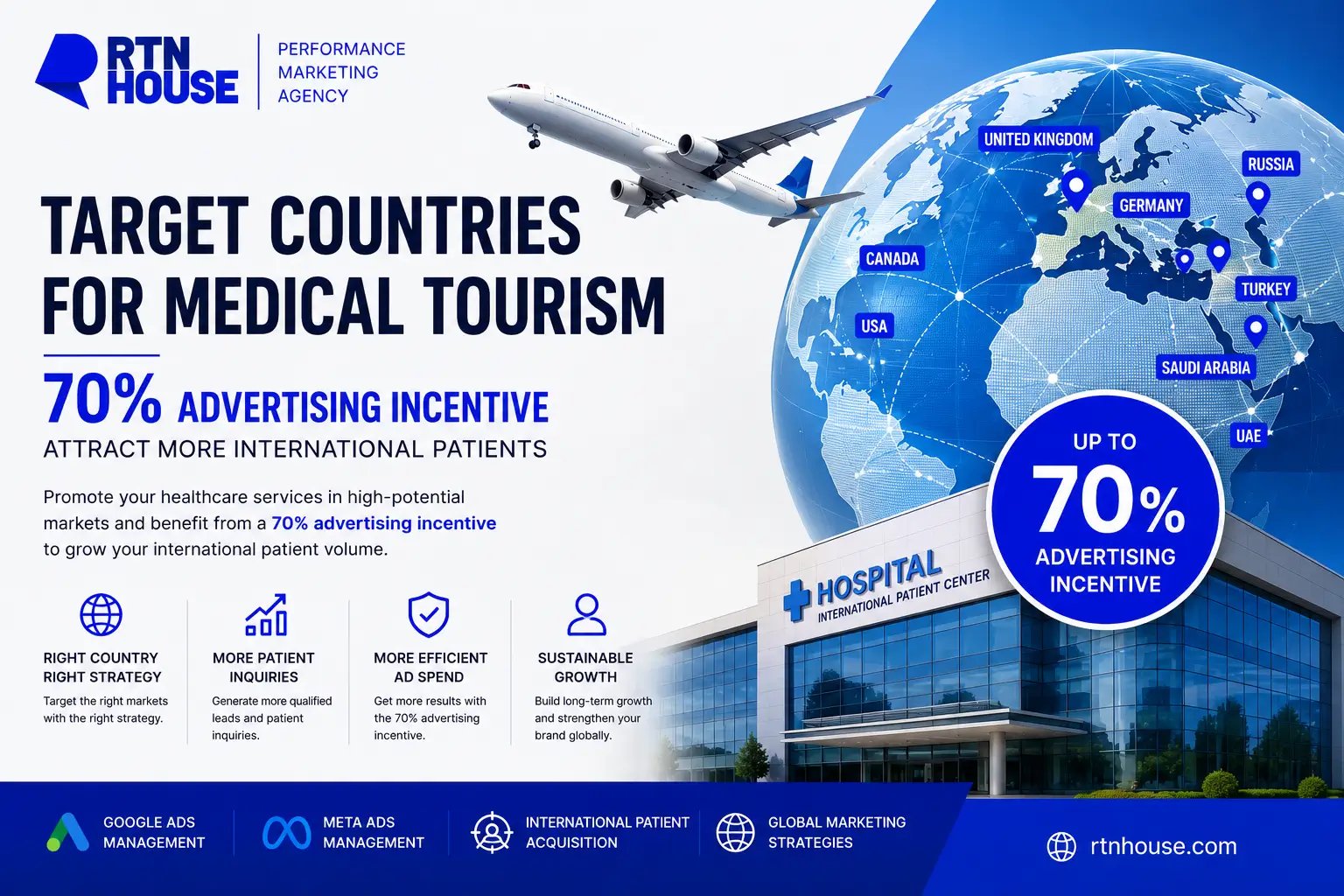
Demand is concentrated in a handful of markets — and each one needs its own language and message:
High spending power and long waiting times. Trust, certification and GDPR compliance are decisive.
Price–quality balance leads; the “trusted alternative” perception matters most.
Strong demand in dental and aesthetics; a native-language page lifts conversion.
Premium positioning, a luxury experience and fast response are expected.
The takeaway for a clinic owner: demand is large and growing, but visibility alone is no longer enough — you need a marketing system built specifically for the international patient.
Why do international patients decide differently?
A local patient evaluates your clinic in person. An international patient evaluates it through a screen, often from thousands of kilometres away, weighing three concerns above all:
- Quality — Is the doctor genuinely qualified? Is the clinic accredited?
- Safety — What happens if something goes wrong? Is there a clear post-treatment plan?
- Cost and clarity — What exactly is included, and are there hidden surprises?
Because they cannot verify any of this in person, they look for proof: accreditation logos, real patient reviews, before-and-after results, doctor credentials and clear, transparent information in their own language. Every missing or confusing element raises doubt — and doubt is what stops a booking.
Which channels actually bring international patients?
No single channel builds a sustainable patient flow. The clinics that grow combine several, in a deliberate order.
1. International SEO & multilingual content
Most patient journeys begin with a search. Ranking for procedure-specific terms in each target language — and answering real questions about cost, recovery, logistics and safety — builds organic, ad-independent demand. A genuinely localised site beats machine translation every time.
2. Paid advertising: Meta + Google together
Meta creates awareness and starts the research process for someone who isn’t searching yet; Google Ads captures intent when a patient is actively looking. Used together with language-matched creative, they shorten the path from first impression to inquiry.
3. A conversion-focused, multilingual website
Traffic without conversion is wasted budget. International patients need fast load times, clear treatment information, visible trust signals and frictionless contact — strong CTAs, simple forms and WhatsApp integration. This is exactly where a purpose-built clinic website and landing page turns ad clicks into qualified inquiries.
4. Trust assets
Accreditation badges (such as JCI), video testimonials from former international patients, transparent doctor profiles and verified reviews are the psychological bridge that lets a stranger commit to surgery abroad.
5. CRM and fast follow-up
Many clinics generate inquiries and then lose them to slow follow-up. A proper CRM ensures every lead is tracked, nurtured in their language and answered quickly — often the difference between an inquiry and a booked patient.
One system, not one channel
When SEO, paid media, a multilingual website and CRM work as a single system, the result is a patient pipeline that keeps producing even when ad spend pauses — instead of a flow that stops the moment you turn the ads off.
How do you build a medical tourism marketing strategy, step by step?
A repeatable framework beats scattered tactics. This is the structure we apply for clinics at RTN House:
- Discovery & research — your services, strongest procedures, competitors and winnable markets.
- Target-market selection — specific countries (UK, Germany, Netherlands) by demand, cost gap and cultural fit, not “everyone, everywhere.”
- Positioning & messaging — what makes your clinic credible and different, expressed consistently.
- Channel prioritisation — technical foundation and multilingual site first, then SEO, then paid acquisition.
- Creative & conversion — language-matched ads, landing pages and trust content built around patient intent.
- Tracking & optimisation — measure cost per lead, conversion rate and revenue per patient, then reallocate budget toward what works.
What mistakes cause clinics to lose international patients?
- Relying on a single channel. One ad account or one language is fragile — when the budget stops, the patients stop.
- Language mismatch. English ads to a German-speaking audience, or machine translation, quietly destroy conversion.
- A slow or untranslated website. Long load times and unclear information lose patients before they ever inquire.
- No follow-up system. An inquiry that waits 48 hours is usually lost to a faster competitor.
How do you measure success in medical tourism marketing?
Avoid judging performance by a single number. A healthy view combines the short term (cost per lead, lead-to-consultation conversion, average revenue per patient), the medium term (organic traffic growth, review score, referral rate), and the long term (brand awareness, market share, and a sustainable flow of organic patients). When every channel works as one system, the result is a pipeline that keeps producing while you sleep.
Frequently asked questions
What is the best marketing strategy for medical tourism?+
How do clinics attract international patients online?+
Why is Turkey a leading medical tourism destination?+
How long does medical tourism marketing take to show results?+
Build your international patient pipeline
From target-country selection to multilingual websites, performance ads and CRM — let’s engineer the end-to-end system together for the UK, DACH and Dutch markets.
Let’s Talk on WhatsApp →
Leads performance marketing for health tourism and e-commerce brands at RTN House — specialising in Meta & Google Ads, conversion-focused web design and multilingual content for the UK, DACH and Dutch markets.