Building a Health Tourism System from Scratch in 24 Months:
Two years ago, when we sat down with plastic surgeon Dr. Yasin Kürşad Varsak at RTN House, there was a lot to be done: the medical tourism infrastructure was in its infancy and had not yet taken on a systematic structure; the volume of international patients was limited; and digital and operational processes were fragmented.
Today, 20–30 international patients come to Istanbul each month for surgery at Dr. Varsak’s clinic. And these patients share a common trait: they are quality-focused individuals who seek results rather than just price, compare doctors when making a choice, and take the time to research before deciding. There is a steady flow of leads from the UK, US, and Australian markets. The system that has brought Dr. Varsak’s surgical expertise to the international market is now fully operational; growth depends not on a single person’s daily oversight but on the system’s own operations.
In this article, we’ll walk you through those 12 months step by step—what worked, what didn’t, and most importantly, how we shattered the “cheap alternative” perception that dominates Turkish medical tourism.
A surgeon's perspective on the system we built together.
“In the early months, my concern was not whether patients would come — it was how we would keep up with the speed of the inquiries. Looking back a year later, the strongest part of this project wasn't the advertising; it was the decision-making discipline we built together. The RTN House team worked with us not as an outside agency, but as part of the clinic itself.”
The Real Challenge: Breaking the “Turkey = Cheap” Perception
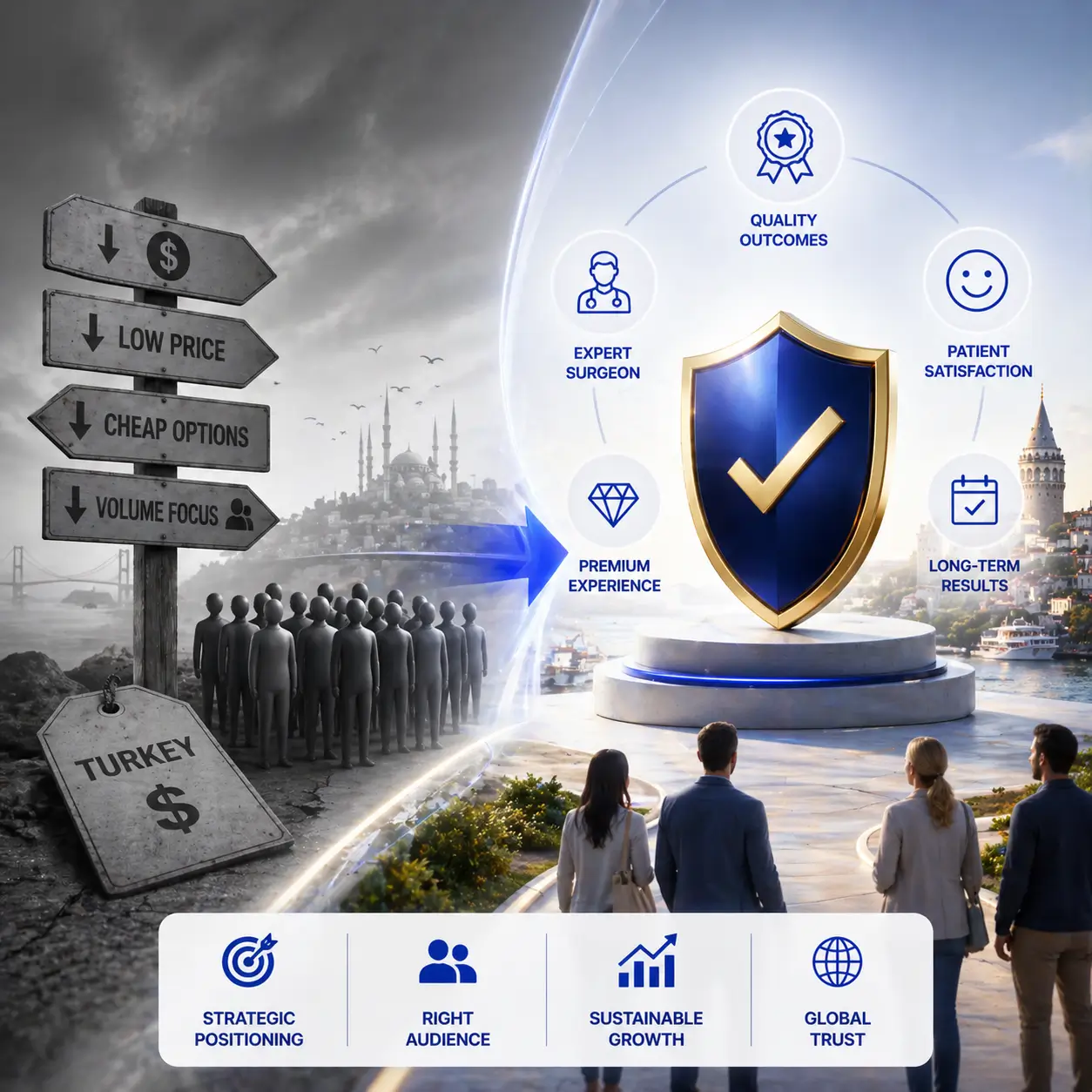
In the international medical tourism market, the perception of Turkey is largely based on a single idea: “The same surgery, at half the price in Turkey.” This perception serves as a selling point for many clinics. However, in Dr. Varsak’s project, it was our biggest obstacle.
Dr. Varsak does not position himself based on price competition; he is a physician who grows his practice through the quality of results and long-term patient satisfaction. This means a completely different game when it comes to digital marketing. Because a significant portion of the international patient base searching for “Turkey” is already looking for “the cheapest” option. We needed to reach not that audience, but a smaller yet entirely different one.
To reach this audience, we built the entire digital infrastructure around a four-tier positioning strategy:
1. Negative keywords:
Excluding low-intent, price-driven traffic was more important than chasing high-value queries. In our Google Ads campaigns, we completely eliminated searches such as “cheapest,” “discount,” “affordable,” “budget,” and “cheap deals.” In an industry where most agencies focus heavily on positive keywords, our negative keyword list became even more critical than the positive one. This alone kept a large volume of low-converting traffic outside our ad budget from the very beginning.
2. Results over price in creatives:
We never displayed prices or promoted discounts in our Meta and Google creatives. We did not use messages like “for X amount.” Because that type of communication attracts the exact opposite audience we wanted. Instead, we focused on real patient results, post-op visuals from day 7, day 30, and month 6, educational videos narrated by Dr. Varsak himself, and short documentary-style videos showing the patient journey inside the clinic. While most competitors start with “affordable rhinoplasty,” we asked a different question: “Who are you trusting with this process?”
3. The doctor’s background as the advertisement itself:
The strongest pillar of this positioning was not ad copy, but Dr. Varsak’s professional background. His international training and fellowships, presentations at global congresses, annual case volume for specific procedures, academic publications, and professional memberships became the core message. What originally existed as a “CV page” on the clinic website was distributed across the entire digital ecosystem — from the hero section of the landing page to the first three seconds of ad creatives and even the opening scripts of the sales team. Because a patient searching for the cheapest option never asks, “Who is the doctor?” A patient who cares about results asks only that.
4. Budget filtering in the lead form:
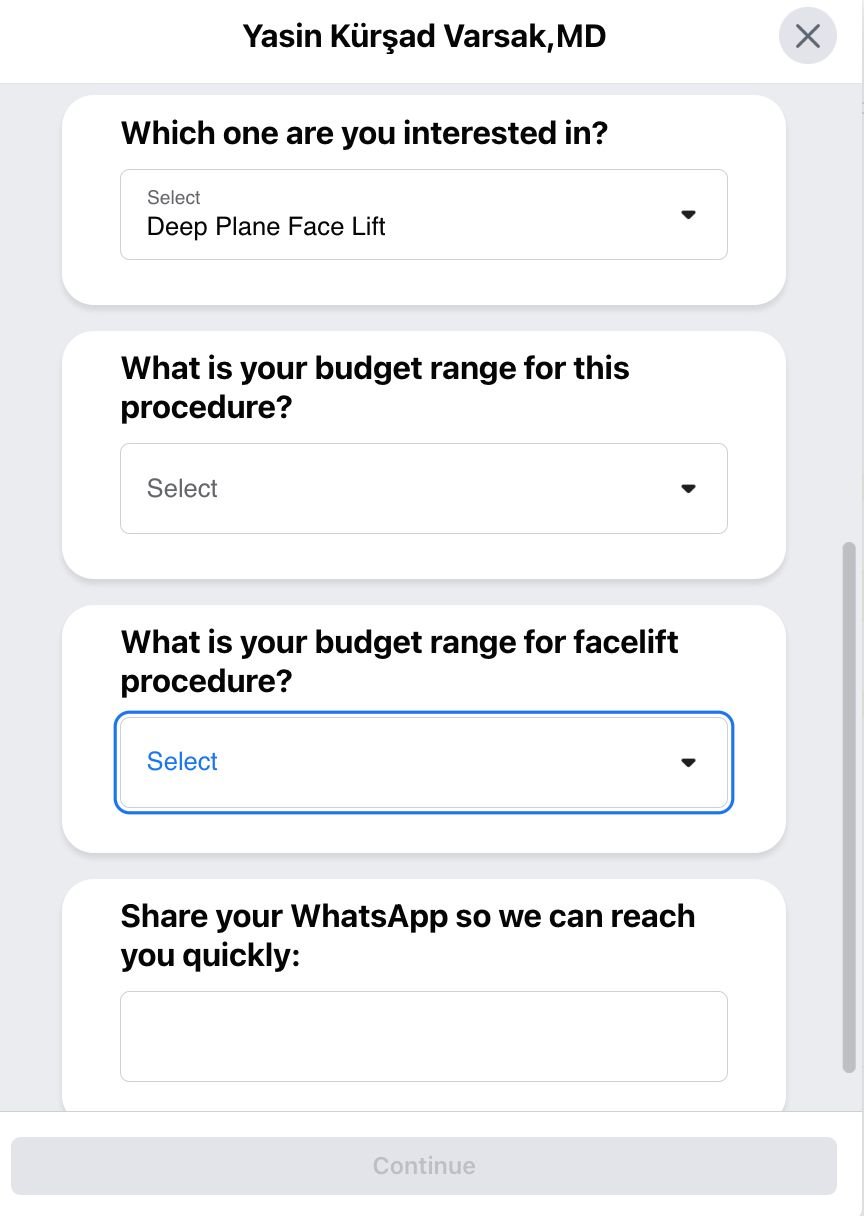
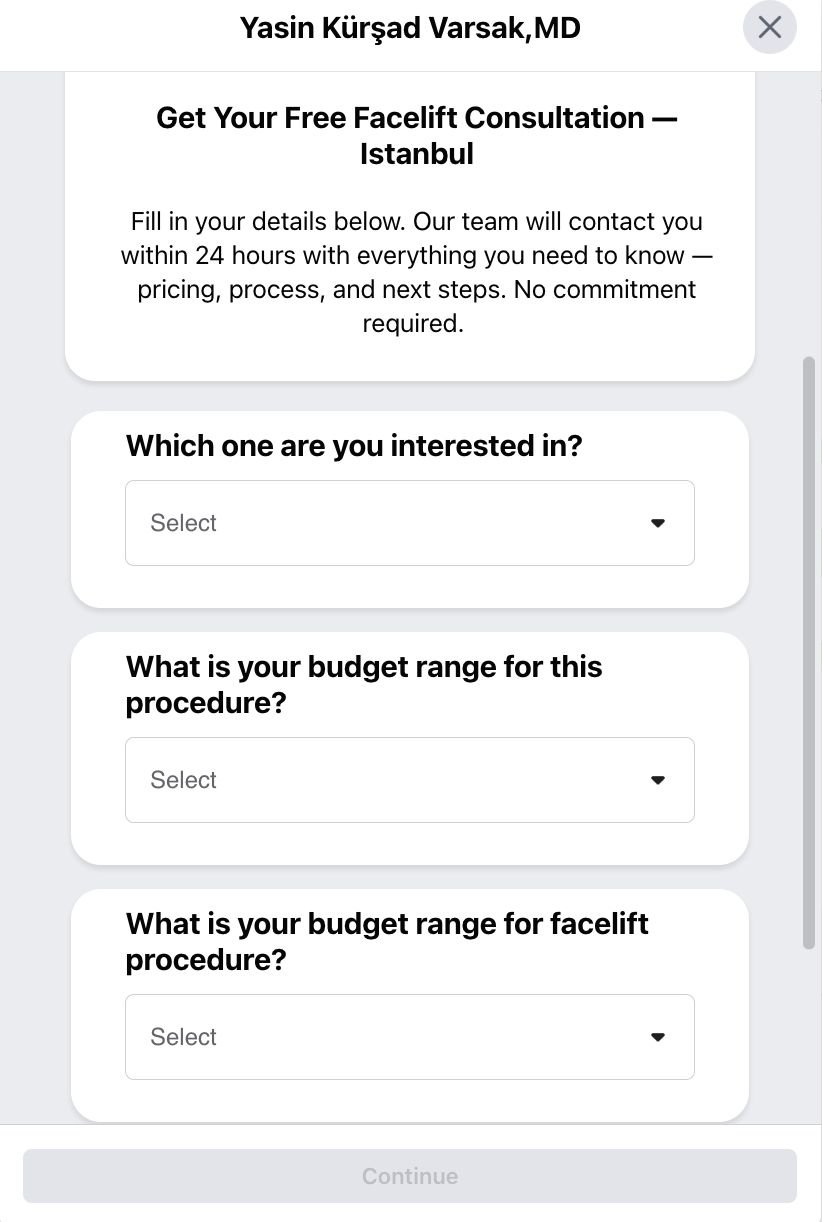
The most critical part of the form became the budget range question. We didn’t ask it bluntly as “What is your budget?” Instead, we designed it as a natural part of the flow, presented in ranges to better understand the patient’s expectations. This allowed early-stage alignment between both sides and helped us identify patients whose expectations did not match the clinic’s pricing before entering the sales process. Before introducing this question, a significant portion of the sales team’s time was spent on conversations with mismatched expectations. Afterward, they focused only on meaningful discussions.
When these four layers worked together, the result was clear:
The number of leads decreased, but the probability of each lead converting into a sale increased significantly.
The most important lesson we learned from this project:
In a quality-focused patient profile, success is not about generating more leads — it’s about generating the right leads.
Starting Point: Why System Comes First
Most clinics entering health tourism make the same mistake: they turn on their ad budget, leads start flowing in, but the majority are lost — either left unanswered, poorly segmented, or simply ignored because the sales team is overwhelmed. Money is spent, but patients don’t come.
To avoid falling into this trap, we spent the first 6 weeks without running any ads. During that time:
- We built a conversion-focused landing page architecture
- We mapped the entire journey from the moment a lead comes in to the final surgery decision
- We designed the sales and patient communication model
- We set up the CRM infrastructure
In health tourism, traffic can be bought — but patient trust cannot.
Trust is an output generated by the system.
Landing Page: The Visual Expression of Strategy
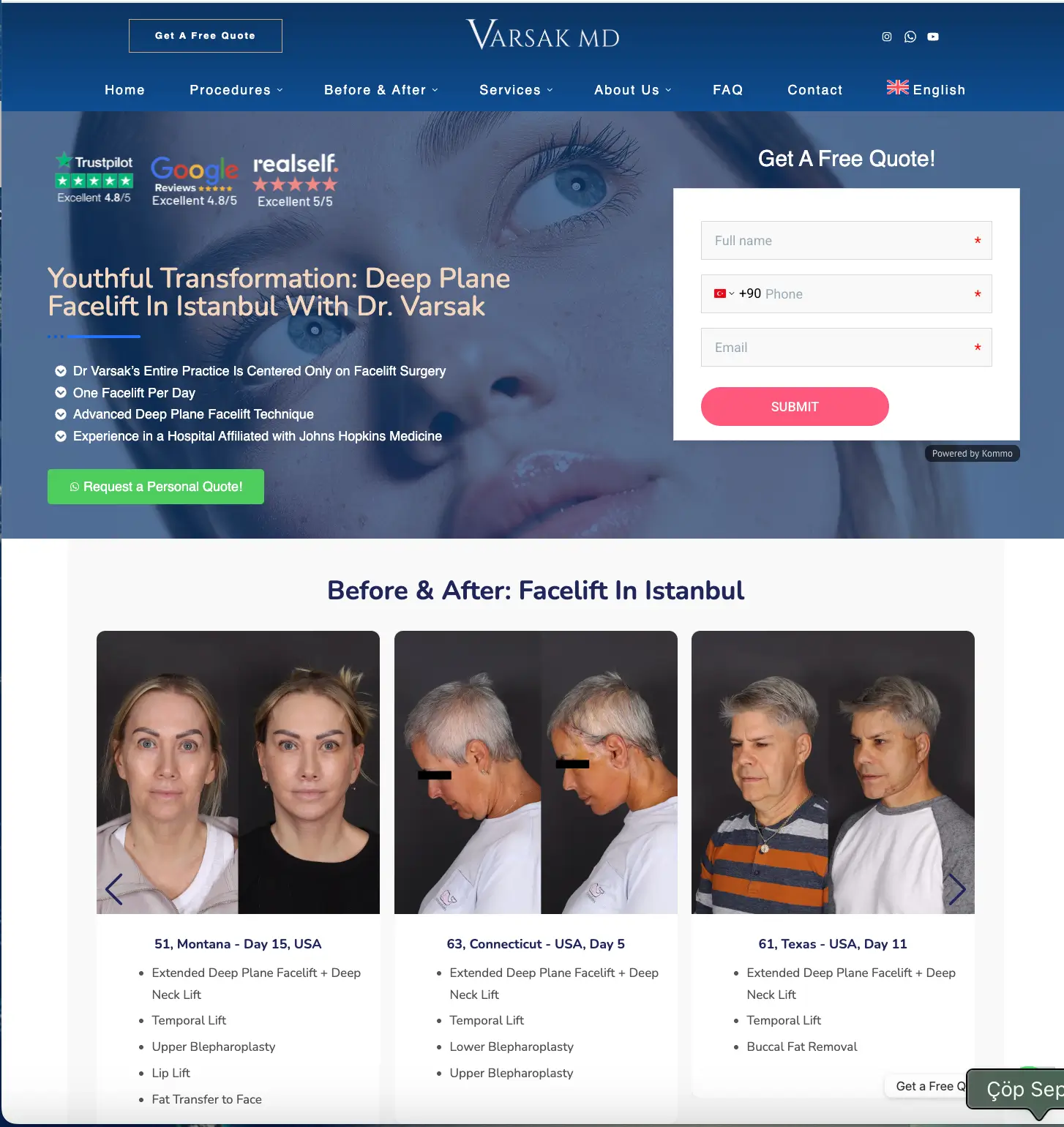
The tangible version of the positioning we’ve described throughout this article can be seen in the facelift landing page we built for Dr. Varsak:
drvarsak.com/facelift-in-istanbul
This is not a subpage of a typical clinic website. It is an independent conversion structure focused on a single service, designed specifically for a quality-driven patient profile. Even the URL structure reflects this — “/facelift-in-istanbul/” instead of “/our-services/”.
Three Key Strategic Decisions in the Page Design
“One Facelift Per Day” — Rejecting Volume
One of the four key messages at the very top of the page is: “One Facelift Per Day.”
This single sentence serves as a direct response to the dominant perception in Turkey’s health tourism market. Most clinics proudly highlight volume metrics such as “daily capacity” or “number of monthly surgeries.” We did the exact opposite.
We placed the fact that only one surgery is performed per day in the most visible area of the page. Because for the target patient, a clinic performing 8 surgeries a day is not a selling point — it’s a reason to walk away.
In the same section, the statement “Dr. Varsak’s Entire Practice Is Centered Only on Facelift Surgery” reinforces specialization through focus — not a surgeon performing 20 different procedures, but one fully dedicated to a single area of expertise.
Not Marketing, But Information
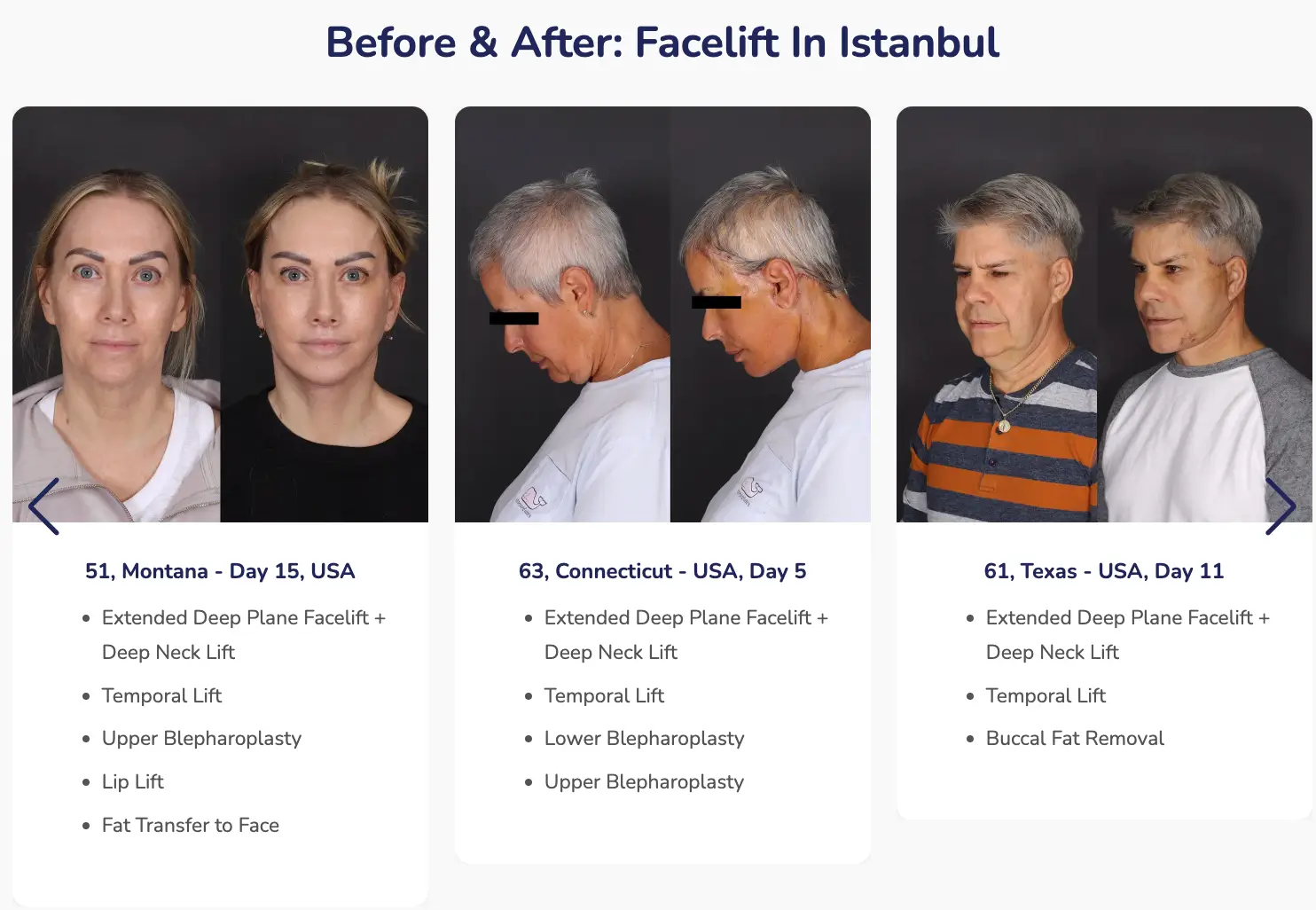
The before/after section on the page is not a standard image gallery. Each case is presented in a medical report format, labeled with details such as “51, Montana – Day 15, USA,” followed by the exact techniques applied.
When the patient’s age, location, post-operative timeline, and surgical methods are clearly and transparently presented, the reader feels they are receiving information—not marketing.
The same logic continues in the FAQ section at the bottom of the page. Twelve detailed questions are answered, covering topics such as pre-operative preparation, airport preferences, anesthesia, scar placement, and timelines for returning to flights and work life.
This level of detailed information ensures that by the time a patient speaks with the sales team, most of their fundamental questions have already been answered. As a result, the nature of the conversation shifts—from interrogation to collaborative decision-making.
Not Price, But Surgeon Selection
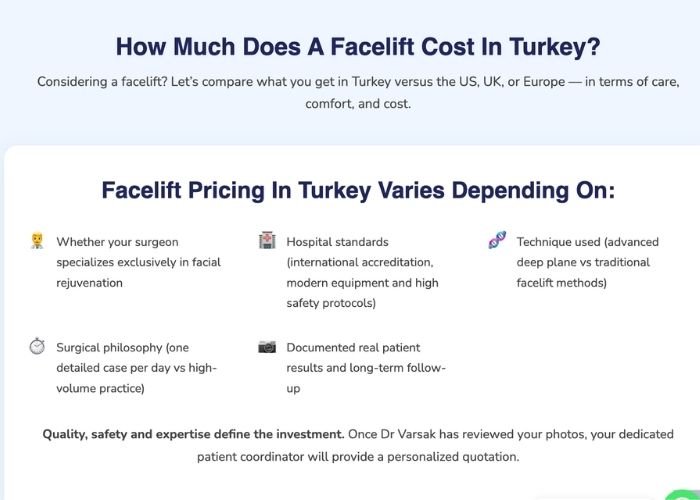
The section titled “How Much Does a Facelift Cost in Turkey?” was designed with an unconventional approach for the health tourism industry.
Instead of listing a price, it outlines five key factors that determine cost:
- Whether the surgeon focuses exclusively on facial procedures
- Hospital accreditations
- The surgical technique used
- The surgical philosophy (one detailed case per day vs. high-volume operations)
- Documented long-term follow-up results
The section concludes with a single sentence that captures the core message:
“Choosing the Right Surgeon Matters More Than Geography.”
This line serves as one of the most elegant responses to the “Turkey = cheap” perception. It doesn’t argue that Turkey is expensive or cheap—it removes the conversation from geography entirely and reframes it around surgeon selection.
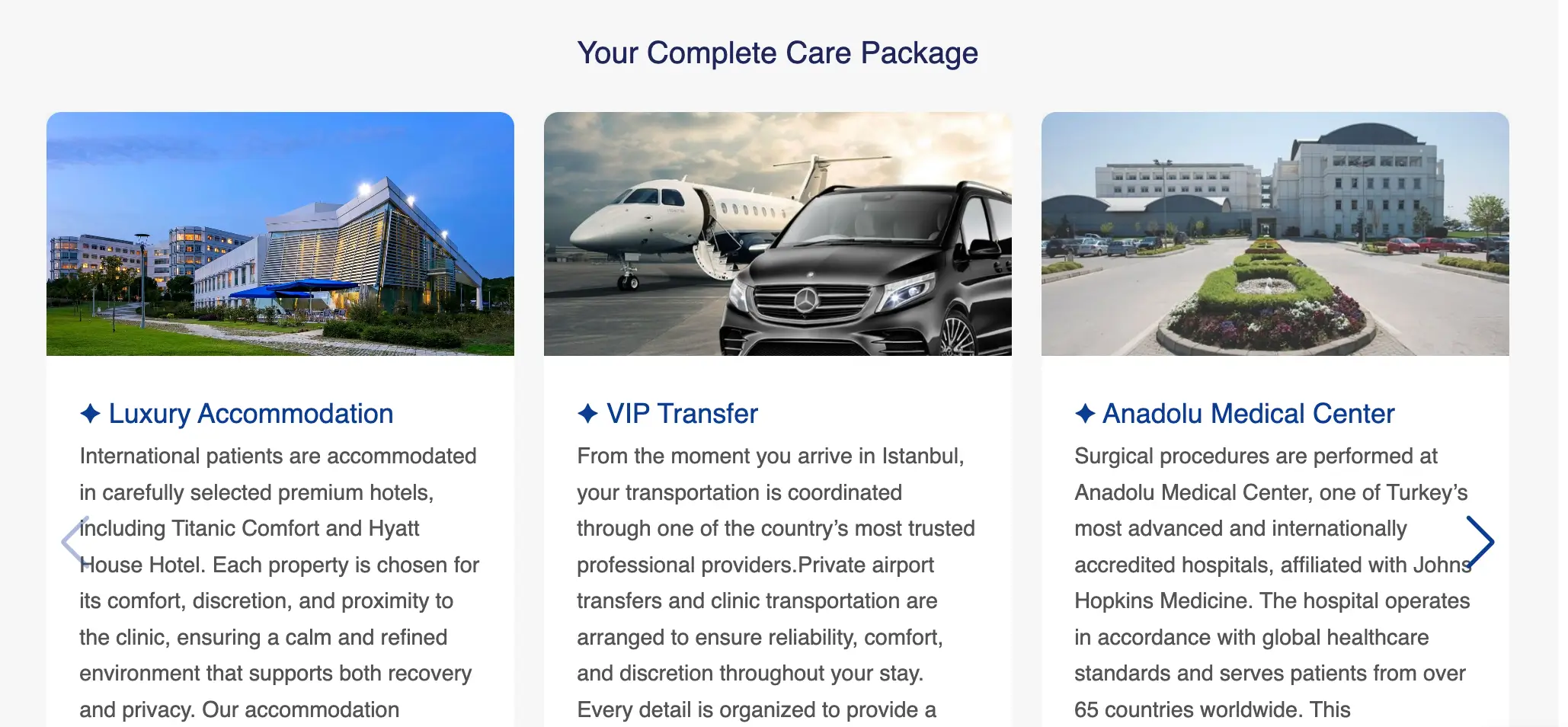
The same philosophy extends to the patient experience package: Luxury Accommodation, VIP Transfer, treatment at the Johns Hopkins Medicine-accredited Anadolu Medical Center, and complication insurance are presented not as “free” or “bonus” offers, but as a standard level of care. These three decisions all serve the same principle: rather than overwhelming the user with information, they guide them toward action with the right information. Together, they form a positioning manifesto condensed into a single page.
“Choosing the Right Surgeon Matters More Than Geography.”
This line serves as one of the most elegant responses to the “Turkey = cheap” perception. It doesn’t argue that Turkey is expensive or cheap—it removes the conversation from geography entirely and reframes it around surgeon selection.
The same philosophy extends to the patient experience package: Luxury Accommodation, VIP Transfer, treatment at the Johns Hopkins Medicine-accredited Anadolu Medical Center, and complication insurance are presented not as “free” or “bonus” offers, but as a standard level of care. These three decisions all serve the same principle: rather than overwhelming the user with information, they guide them toward action with the right information. Together, they form a positioning manifesto condensed into a single page.
Traffic Strategy: Intent, Not Volume
Google Ads
We started with high-intent search campaigns. We focused on queries close to the decision-making stage, such as “facelift in Turkey” and “rhinoplasty Istanbul”; we optimized the UK, US, and Australian markets separately because the search behavior, price sensitivity, and decision-making time for these three markets differ significantly.
The underlying layer of this structure was the negative keyword strategy we mentioned earlier—half of the campaign budget was spent on terms to exclude, not positive keywords.
Meta Ads
The logic here was different: people don’t search for surgery on Meta; they discover it. We built a three-tiered structure:
Brand and doctor promotion to cold audiences
Users nearing the decision-making stage via lookalike audiences
Remarketing to those who visited the website and left
The creative strategy was clear from the start: no price messaging, only results-based messaging.
Our First Attempt at a Lead Form
We started with a standard lead form in the first month. Two weeks later, we received the following feedback from the sales team: “Half of the leads are either from the wrong country, not a good fit for the service, or just want to know the price—they’re not ready for a value-based conversation.”
This feedback led us to redesign the form from scratch. We added two manual filter questions, then set up a conditional flow—the form changes based on the user’s response, collecting only relevant information. We also integrated the budget range question into this new form at this stage. The number of leads decreased, but the sales team’s conversion rate increased significantly.
Lead to Sale: The Breaking Point
In health tourism, most of the money is lost in the first 30 minutes after a lead arrives. If a patient submits a form and the response is delayed, they're most likely already talking to another clinic.
That's why in the system we built:
- Every lead reaches the sales team as an instant notification
- First-contact target is under 15 minutes
- Lead pipeline, patient segmentation, and follow-up scenarios are defined inside the CRM
- Unanswered leads automatically enter a second round
This process wasn't built in a day. At the end of month three, in a meeting with the sales team, we realized that different people were responding to the same lead at different times — and the patient was getting confused.
Agency, Doctor, Sales Team: The Triangle's Secret
The strongest part of this project wasn't the landing page or the ad optimization. It was the weekly meetings where all three parties sat at the same table.
Every week we discussed:
- What kind of experience the patient from each campaign actually had
- Which objections the sales team encountered — whether they came from the ads, the price, or trust
- What missing information Dr. Varsak noticed on the clinical side
These meetings fed directly into ad creatives, landing page copy, and form questions. Field data flowed back into the ads, ad data into the sales process, and sales data into the clinical experience.
24-Month Milestones
-
01Mo 1–2System setup
Landing page, CRM, sales flow, negative keyword list. No ads yet.
-
02Mo 3First campaigns launched
First international patients arrived. Initial issues with the lead form were identified.
-
03Mo 4–6Conditional form structure and budget filter
Visible improvement in lead quality. Monthly patient count moved into double digits.
-
04Mo 7–9Market-based segmentation
Separate creative sets for the UK and US; an operational adjustment for Australia accounting for the time-zone gap.
-
05Mo 10–12First scale
Monthly patient count settled into stable double digits. First lift in organic inquiries appeared.
-
06Mo 13–15Year-two creative refresh
First-year data clarified which messages worked best in which market; the creative structure was rebuilt on top of that data.
-
07Mo 16–18Remarketing and lookalike pools matured
With patient data accumulated over the first 12 months, target audiences on Meta and Google became significantly more accurate; a lasting drop in lead cost.
-
08Mo 19–21Notable rise in referral patients
Previous patients' shares, reviews, and word-of-mouth began producing a flow on par with the digital channels.
-
09Mo 22–24Mature system
A stable structure of 20–30 surgeries per month. Most of the process now runs on the system itself, not on one person's daily oversight.
Results
After 24 months:
- International patient volume grew roughly 10x
- A stable structure of 20–30 surgeries per month was established
- Sustainable lead flow was achieved in the UK, US, and Australia
- Dr. Varsak's surgical expertise no longer stands alone — it now moves forward together with the digital and operational system that carries it
- And most critically: this volume was achieved without ever leaning on the "cheap Turkey" narrative, by reaching a quality-focused patient profile
What We Learned
This project taught us a few things specific to the industry:
- With a quality-focused patient profile, success means more accurate leads, not more leads
- For a clinic that isn't positioned on price, the negative keyword list matters at least as much as the positive one
- A doctor's professional background isn't information to be confined to an "about" page — it can be the ad creative itself
- On a landing page, care metrics like "one surgery per day" send a stronger signal to premium patients than volume metrics like "daily capacity"
- In the UK, decision time is longer — remarketing is essential. In the US, the decision is faster but doctor selection is researched in more detail
- Without a budget filter, lead count is misleading — the visible volume doesn't reflect the real volume
- Feedback from the sales team on the ad can provide insights faster than the agency's A/B test
Key Takeaways
Success in health tourism does not come from ad spend alone. It comes from strategy, systems, team alignment, and a continuous feedback loop from the field back into marketing.
And most importantly: defining who you do not want to reach is just as critical as defining who you do. Without a clear negative definition, sustainable positive results are not possible.
The practical implementation of the system described in this article can be seen at: drvarsak.com/facelift-in-istanbul
Final Insight
Success in health tourism does not come from ad spend alone.
It comes from strategy, system, alignment, and feedback loops.
And most importantly: Defining who you don’t want is just as critical as defining who you do.
Let's build the next system for your clinic
We build proven infrastructure for sustainable international patient flow in health tourism. The first call is a discovery session — together we map out what will actually work for your clinic.


